
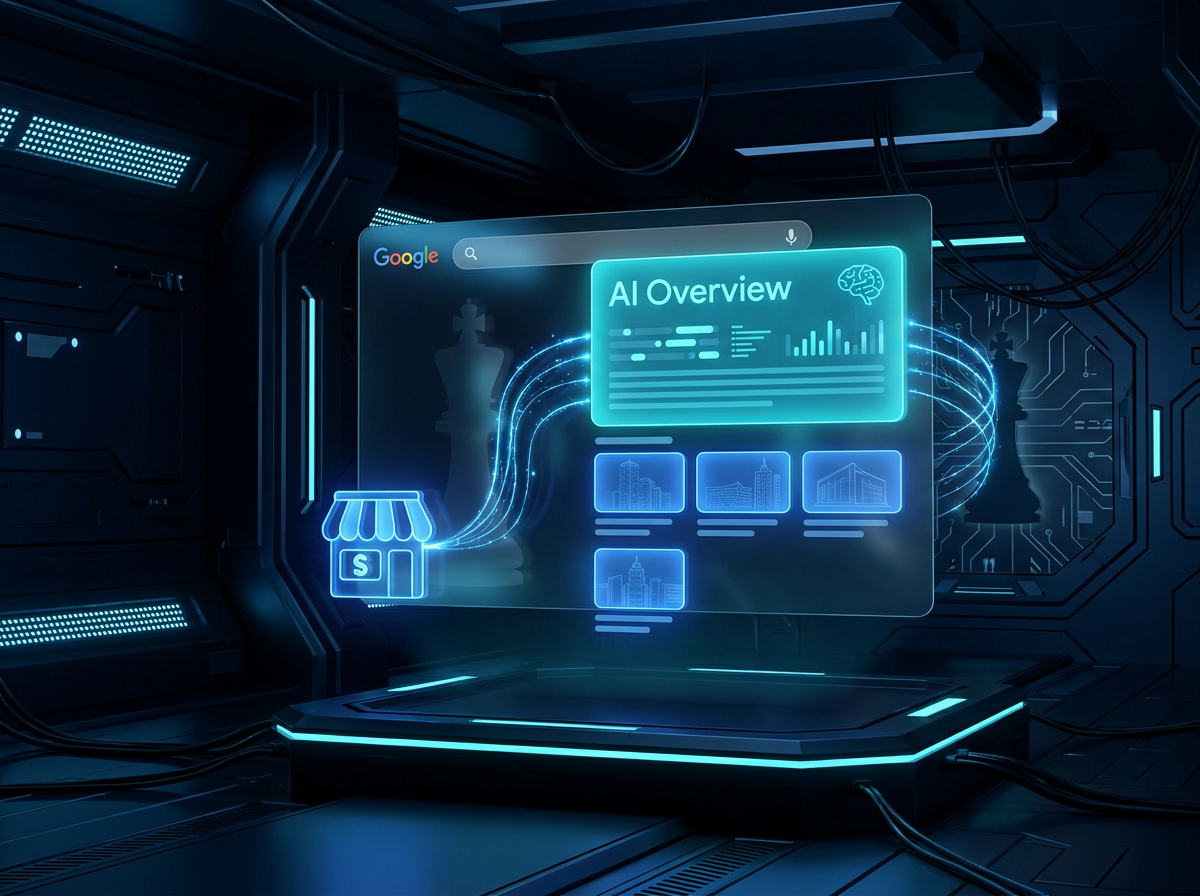
What AI Overviews Mean for Small Business Websites in 2026
Imagine working for years to build a website that ranks on page one — and then Google decides to summarize your entire industry in a blue box before anyone even sees your link. Welcome to 2026, where AI Overviews have officially changed the game. The question isn't whether this affects you. It does. The question is: are you going to be cited in that blue box, or buried under it?
I've been running AI visibility audits for small business websites this year, and the pattern is clear: most small business sites are invisible to AI search systems — not because they're bad sites, but because they're structured for humans, not for machines trying to extract knowledge at scale. That gap is exactly what we're covering today.
What Is a Google AI Overview, Exactly?
A Google AI Overview is that AI-generated summary block that now appears at the top of many search results — above the traditional blue links, above local map packs, above everything. Google's AI synthesizes information from multiple websites and presents a direct answer to the user's query. At the bottom of the summary, it lists the sources it pulled from.
Those source links? That's where you want to be. Being cited in an AI Overview is the 2026 equivalent of ranking #1 on Google — except it's arguably more valuable because your site appears at the exact moment someone is actively seeking information in your industry.
Think of it like chess. In the old game, you fought for the best square on the board. Now the board has a new piece at the top — and if you ignore it, your opponent takes it every single time.
The Real Traffic Impact for Small Businesses
Here's the honest breakdown — because honest is the only way I operate.
If your site is not cited in AI Overviews, your organic click-through rate on competitive queries is almost certainly dropping. Users get the answer they need without clicking. Studies in early 2026 have shown click-through rate reductions of 15–35% on informational queries where AI Overviews appear. That's not a typo. That's a real hit.
If your site is cited in an AI Overview, the story flips. The traffic you do receive is higher-intent — people who clicked through already read a summary and want to know more. Conversion rates from AI Overview referral traffic tend to be significantly above average.
Bottom line: the middle ground is disappearing. You're either a source or you're a footnote. There is no comfortable third option.
Why Most Small Business Websites Are Invisible to AI
Google's AI systems don't read your website the way a human does. They extract structured meaning. They look for entities, relationships, credentials, and topic authority — all of which need to be signaled in ways that machines can parse.
Most small business websites were built for human visitors: nice design, a services list, a contact form, maybe a few testimonials. That's fine for converting people who already found you. But it doesn't tell Google's AI who you are as an entity, what topics you are an authority on, or why your content is more trustworthy than a competitor's.
The five things AI systems look for — and that most small business sites are missing:
- Schema markup (structured data that labels your content for machines)
- Entity recognition (Google knowing 'who' you are, not just 'what' you sell)
- Topical authority (deep content clusters, not just a homepage + services page)
- E-E-A-T signals (Experience, Expertise, Authoritativeness, Trustworthiness — in structured form)
- FAQ and Q&A formatted content (exactly the format AI systems extract answers from)
What "Entity Recognition" Means and Why It Matters More Than Keywords
In traditional SEO, you optimized for keywords — specific phrases people typed into search. That's still important, but it's no longer enough. Google's AI now thinks in entities: real-world people, places, businesses, and concepts that it can connect to a knowledge graph.
For your small business, this means Google needs to understand "this is a real company, run by a real person, with verifiable credentials, in a specific location, serving a specific market." When that entity is established, Google starts treating your content as a credible source — rather than an anonymous website making unverifiable claims.
How do you establish entity recognition? Through schema markup (specifically Organization, Person, LocalBusiness, and Service schemas), consistent NAP data across the web (Name, Address, Phone), external citations, and content that consistently covers your subject area with depth and specificity.
The Content Format AI Overviews Love
Google's AI is extracting answers, not reading essays. The content formats that get cited most consistently are:
- FAQ sections — direct Q&A format with clear, complete answers (this is why this post has a full FAQ section below)
- Step-by-step processes — numbered lists that explain how something works
- Definitions — clear explanations of industry terms in plain language
- Comparisons — structured breakdowns of Option A vs. Option B
- "What is..." and "How to..." formatted headings — these match user query patterns exactly
Notice what's not on that list? Fluffy mission statements. Generic "we are passionate about helping businesses" paragraphs. Walls of text with no structure. If your homepage and service pages are written like a brochure, they're invisible to AI systems.
A Practical AI Visibility Checklist for Small Business Websites
Here is a prioritized action list. Not everything can be done overnight, so I've ordered these by impact:
Add Organization + Person + LocalBusiness schema to your site
Add FAQPage schema and a visible FAQ section to your homepage and service pages
Create content that directly answers the top 10 questions your customers ask
Build an About page that establishes the founder/team as a named entity with credentials
Add Article schema to every blog post with author, publisher, and datePublished
Build topical clusters — 6-10 blog posts around each core service area
Earn citations from directories, guest posts, and press mentions
The Honest Reality: This Takes Time, but the Window Is Still Open
Here's the part where I could hype you up with "act now before it's too late!" But that's not how I operate. The truth is: Google's AI Overview ecosystem is still maturing. Most small businesses haven't started optimizing for it yet. That means the window to establish authority as a cited source is genuinely open right now — but it won't stay open forever.
The businesses that invest in structured data, entity recognition, and authoritative Q&A content in 2026 will have a significant head start over those who wait until 2027 wondering why their traffic collapsed. In chess terms: the opening moves matter. The endgame is decided in the first few moves, not the last.
You don't need a massive budget to do this well. You need a clear strategy, the right technical setup, and consistent content output. That's exactly what we help small businesses with at TomPaul Digital Marketing — whether through a one-time audit or an ongoing SEO and web design package.
Frequently Asked Questions
AI Overviews & Small Business SEO — Your Questions Answered
What is a Google AI Overview?
A Google AI Overview (formerly called SGE — Search Generative Experience) is an AI-generated summary that appears at the very top of certain Google search results. Instead of showing just a list of links, Google's AI synthesizes information from multiple trusted sources and presents a direct answer. Websites that are cited in these summaries receive a source link — which can drive highly qualified traffic.
Do AI Overviews hurt website traffic?
It depends on your strategy. For websites that are not cited in AI Overviews, yes — traffic can drop because users get answers without clicking. For websites that ARE cited as sources, AI Overviews can actually drive high-intent traffic from people who want to learn more. The goal is to become a cited source, not a buried result.
How do I get my small business website to appear in AI Overviews?
To appear in Google AI Overviews, your website needs: (1) structured data / schema markup, (2) clear, authoritative content that directly answers common questions in your industry, (3) a strong E-E-A-T profile (Experience, Expertise, Authoritativeness, Trustworthiness), (4) entity recognition — Google needs to know who you are and what you do as a named entity, and (5) topical depth — your site should cover its subject area comprehensively, not just list services.
What is structured data and why does it matter for AI search?
Structured data (also called schema markup) is code you add to your website that tells search engines exactly what your content means — not just what it says. For example, schema markup can tell Google that a block of text is an FAQ, a service offering, a review, or a person's credentials. AI systems like Google's AI Overviews rely heavily on structured data to decide which websites are trustworthy sources worth citing.
Is AI Overview optimization the same as regular SEO?
It overlaps significantly but is not identical. Traditional SEO focuses on keyword rankings and backlinks. AI Overview optimization adds a layer of entity-based SEO — helping Google understand who you are, what topics you are an authority on, and why your content is worth citing. You still need good SEO fundamentals, but AI visibility also requires structured data, topical authority, and entity recognition that most basic SEO strategies don't cover.
How long does it take to start appearing in AI Overviews?
There is no guaranteed timeline — Google controls which sources it cites. However, adding proper schema markup, creating authoritative FAQ content, and strengthening your E-E-A-T signals typically begins to show results within 3–6 months. New websites with no domain authority will take longer than established sites. Consistency and quality of content matter more than speed.
Does my business need a blog to rank in AI Overviews?
A blog is one of the most effective tools for AI Overview visibility — but it must be done strategically. Blogs that answer specific, high-intent questions in your industry are far more likely to be cited than generic company news posts. Focus on topics your customers actually search for, write in clear Q&A or how-to formats, and back your claims with real experience and data.
Want to Know How Your Site Scores for AI Visibility?
We run full AI visibility audits as part of our free consultation — no obligation, no jargon, just a clear picture of where you stand and what to fix first.
Get Your Free AI Visibility Audit